
aesthetics n. 1. The branch of philosophy that provides a theory of the beautiful and of the fine arts. 2. The theories and descriptions of the psychological response to beauty and artistic experiences. 3. In the philosophy of Kant, the branch of metaphysics concerned with the laws of perception.
cybernetics n. The theoretical study of control processes in electronic, mechanical, and biological systems, esp. the mathematical analysis of the flow of information in such systems.
(The American Heritage® Dictionary of the English Language. Third Edition. Boston: Houghton Mifflin Company)
As necessity seems a cause of invention, so it seems also a cause of meaning. My phrase cybernetic aesthetics, which I coined in 1991, arose from my poetic sense. I intuited that we can think of systems of information as beautiful or ugly. Perhaps the mathematics that describe the relations in cybernetic feedback systems can inform this aesthetic. Perhaps nonlinear feedback creating chaos would work better.
In any event, artists love their tools. With the arrival of the personal computer we have at our disposal an exquisitely versatile tool in which artists can find a multitude of visualizations in a unique and encompassing set of media. Computer technology revolutionizes such formerly diverse activities as publishing, musical composition, and cinematography. The trend suggested in this revolution seems the empowering of the individual by presenting hir with a laptop creativity lab. Now the possibility for the independent artist to write, draw, compose music, fabricate videos, fabricate environments, explore, manipulate, generate worlds of information as a means of creative and communicative expression has arrived. I implore you, my fellow artists, to explore the nature of this mysterious digital medium.
The cybernetic communications between those artists creating from both aspects of their minds, i.e., the poet right brain and the scientist left brain, and those scientists and engineers that use their categorical left and wholistic right, represent to me the direction of the Cybernetic Aesthetic.
Our perception depends on vibration. All so called physical phenomena (except for gravity perhaps) exhibit vibration. We can think of our world as composed only of these vibrations. Vibrations create waves, and every wave goes back and forth. One never sees a natural wave without either of these back and forth components. It seems nature programmed our sense organs with cells that pick up information in our environment from these beating waves. All our senses operate in this way as they send their impressions up the wire to our brains. Our nervous systems respond to subsets of the vibrating universe, and our brains perform their functions on these responses allowing us to perceive. Neuron cells make up our brains and each of these information cells (although tremendously complex in themselves) can send only a very limited electrochemical message to the rest of the brain system, stimulating other neurons. Depending on the incredible programming of our brain system, each brain cell either sends a message to its neighbors or it doesn't send one. It decides. The pattern of these firing cells seems to have a lot to do with our experience of the world.
Can we find then, a message from this brain medium? Could not we say that as our senses send electrochemical messages to our fabulous neuron headquarters (whose job then seems to fire off rounds of info bulletins), we form an impression of the world while ignoring a percentage of the information? Does conscious attention come with ignorance built in? We need, of course, to ignore some of the world to survive it. It wouldn't do to examine deeply all the phenomena of space, time, and self while driving a car. Yet what interesting information might our neurons reflexively throw away in their decision making process? Could we find important information that this process has programmed us to ignore?
In his very interesting The Book: On the Taboo Against Knowing Who You Are, Alan Watts outlined what I consider a fundamental assumption of the Cybernetic Aesthetic: the game of on and off. Calling it the game of black and white, Watts explained how this simple concept eludes many of us, that we make at least two fundamental errors about our perceptions:
The first is not realizing that so called opposites such as light and darkness, sound and silence, solid and space, on and off, inside and outside, appearing and disappearing, cause and effect, are poles or aspects of the same thing. The second, closely related, is that we are so absorbed in conscious attention, so convinced that this narrowed kind of perception is the real way of seeing the world, that we are fully hypnotized by its disjointed view of the universe. In other words we do not play the game of black and white, the universal game of up-down, on-off, solid-space, and each-all. Instead, we play the game of black versus white, or more usually, white versus black.
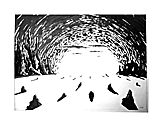
Imagine a wall in front of you that extends with straight lines left and right, up and down, to infinity in all directions. Can you imagine it without a top or a bottom, without an edge? I cannot yet. Every time I picture this infinite wall, my mind's eye may follow it in some direction for a time, but it always seems to run into a mental edge, making it finite. Now imagine the finite wall you have created. Picture the whole thing in your mind. As just stated, when you visualize the wall that you originally meant to picture as infinite it turns finite. Yet when you then give in and conjure the whole finite wall, do you not notice that your mind has suggested infinity because beyond the edges of your wall appears a background? These parts of the game of on and off we call the game of figure and ground. It helps us notice how polar opposites actually complement one another. Can you imagine a figure without a background, or a lone background that extends to infinity?