Audience member(s), please submit any comments you would like posted on this page in the box below. Thank you for participating.
You can think of yourself as a system. Note this entry from a contemporary dictionary:
sys·tem (s<s2túm) n. Abbr. syst. 1. A group of interacting, interrelated, or interdependent elements forming a complex whole. 2. A functionally related group of elements, especially: a. The human body regarded as a functional physiological unit. b. An organism as a whole, especially with regard to its vital processes or functions. c. A group of physiologically or anatomically complementary organs or parts: the nervous system; the skeletal system. d. A group of interacting mechanical or electrical components. e. A network of structures and channels, as for communication, travel, or distribution. 3. An organized set of interrelated ideas or principles. 4. A social, economic, or political organizational form. 5. A naturally occurring group of objects or phenomena: the solar system. 6. A set of objects or phenomena grouped together for classification or analysis. 7. A condition of harmonious, orderly interaction. 8. An organized and coordinated method; a procedure. See note at method. 9. The prevailing social order; the establishment. Used with the: You can't beat the system.
[ Late Latin systTma systTmat- from Greek sustTma from sunistanai to combine sun- syn- histanai set up, establish; See stE- in Indo-European Roots.]
stE-. Important derivatives are: steed stud 2 stool stage stance stanza stay 1 arrest circumstance constant contrast cost distant instant obstacle obstetric rest 2 substance stand understand standard stem 1 station static destine obstinate state statue statute institute prostitute substitute superstition establish stable 1 assist exist insist resist ecstasy system post 1 store steer 1 steer 2
To stand; with derivatives meaning "place or thing that is standing." Contracted from *staú-. I. Basic form *stE-. 1. Extended form *stEdh-. a. STEED, from Old English stTda, stallion, studhorse (< "place for breeding horses"), from Germanic *stÅd-jÅn-; b. STUD 2, from Old English stÅd, establishment for breeding horses, from Germanic *stÅdÅ. 2. Suffixed form *stE-lo-. a. STOOL, from Old English stÅl, stool; b. (see pel- 2 ) Germanic compound *faldistÅlaz. Both a and b from Germanic *stÅlaz. 3. ESTANCIA, STAGE, STANCE, STANCH 1, STANCHION, (STANZA), STATOR, STAY 1, STET; ARREST, CIRCUMSTANCE, CONSTANT, CONTRAST, (COST), DISTANT, EXTANT, INSTANT, OBSTACLE, OBSTETRIC, (OUST), REST 2, RESTIVE, SUBSTANCE, from Latin stEre, to stand. 4. Suffixed form *stE-men-. ETAMINE, STAMEN, STAMMEL, from Latin stEmen, thread of the warp (a technical term). 5. Suffixed form *stE-mon-. PENSTEMON, from Greek stTmÅn, thread. 6. Suffixed form *stE-ro-. STARETS, from Old Church Slavonic starî, old ("long-standing"). II. Zero-grade form *stú- (before consonants). 1. Nasalized extended form *stú-n-t-. a. STAND, from Old English standan, to stand; b. UNDERSTAND, from Old English understandan, to know, stand under (under-, under-; see xdher ); c. STANDARD, from Frankish *standan, to stand; d. STOUND, from Old English stund, a fixed time, while, from secondary zero-grade form in Germanic *stund-Å. a, b, c, and d all from Germanic *standan. 2. Suffixed form *stú-tyo-. STITHY, from Old Norse stedhi, anvil, from Germanic *stathjÅn-. 3. Suffixed form *stú-tlo-. STADDLE, STARLING 2, from Old English stathol, foundation, from Germanic *stathlaz. 4. Suffixed form *stú-mno-. STEM 1, from Old English stefn, stem, tree trunk, from Germanic *stamniz. 5. Suffixed form *stú-ti-. a. (i) STEAD, from Old English stede, place; (ii) STADHOLDER, from Dutch stad, place; (iii) SHTETL, from Old High German stat, place. (i), (ii), and (iii) all from Germanic *stadiz; b. STAT 2, from Latin statim, at once; c. STATION, from Latin statiÅ, a standing still; d. ARMISTICE, SOLSTICE, from Latin -stitium, a stoppage; e. STASIS, from Greek stasis (see III. 1. b.), a standing, a standstill. 6. Suffixed form *stú-to-. a. BESTEAD, from Old Norse stadhr, place, from Germanic *stadaz, placed; b. -STAT, STATIC, STATICE, STATO-; ASTASIA, (ASTATINE), from Greek statos, placed, standing. 7. Suffixed form *stú-no-. a. DESTINE, from Latin dTstinEre, to make firm, establish (dT-, thoroughly; see de- ); b. OBSTINATE, from Latin obstinEre, to set one's mind on, persist (ob-, on; see epi ). 8. Suffixed form *stú-tu-. STATE, STATISTICS, (STATUE), STATURE, STATUS, STATUTE; CONSTITUTE, DESTITUTE, INSTITUTE, PROSTITUTE, RESTITUTE, SUBSTITUTE, SUPERSTITION, from Latin status, manner, position, condition, attitude, with derivatives statñra, height, stature, statuere, to set up, erect, cause to stand, and superstes (< *-stú-t-), witness ("who stands beyond"). 9. Suffixed form *stú-dhlo-. STABLE 2; CONSTABLE, from Latin stabulum, "standing place," stable. 10. Suffixed form *stú-dhli-. ESTABLISH, STABLE 1, from Latin stabilis, standing firm. 11. Suffixed form *stú-tE. -STAT; ENSTATITE, from Greek -statTs, one that causes to stand, a standing. III. Zero-grade form *st-, *st(ú)- (before vowels). 1. Reduplicated form *si-st(ú)-. a. ASSIST, CONSIST, DESIST, EXIST, INSIST, INTERSTICE, PERSIST, RESIST, SUBSIST, from Latin sistere, to set, place, stop, stand; b. APOSTASY, CATASTASIS, DIASTASIS, ECSTASY, EPISTASIS, EPISTEMOLOGY, HYPOSTASIS, ICONOSTASIS, ISOSTASY, METASTASIS, PROSTATE, SYSTEM, from Greek histanai (aorist stanai), to set, place, with stasis (*stú-ti-), a standing (see II. 5. e.); c. HISTO-; HISTIOCYTE, from Greek histos, web, tissue (< "that which is set up"). 2. Compound form *tri-st-i-, "third person standing by" (see trei- ). 3. Compound form *por-st-i-, "that which stands before" (*por-, before, forth; see per 1 ). POST 1, from Latin postis, post. 4. Suffixed form *st-o- in compound *upo-st-o-, "one who stands under" (see upo ). IV. Extended root *stEu- (< *staúu-), becoming *stau- before consonants, *stEw- before vowels; basic meaning "stout-standing, strong." 1. Suffixed extended form *stEw-E. STOW, from Old English stÅw, place, from Germanic *stÅwÅ. 2. Probable o-grade suffixed extended form *stÅw-yE. STOA, STOIC, from Greek stoa, porch. 3. Suffixed extended form *stau-ro-. a. (i) STORE; INSTAURATION, from Latin hnstaurEre, to restore, set upright again (in-, on; see en ); (ii) RESTORE, from Latin restaurEre, to restore, rebuild (re-, anew, again; see re- ); b. STAUROLITE, from Greek stauros, cross, post, stake. 4. Variant *tau-ro-, bull (see tauro- ). V. Zero-grade extended root *stñ- (< *stuú-). Suffixed form *stñ-lo-. STYLITE; AMPHISTYLAR, ASTYLAR, EPISTYLE, HYPOSTYLE, PERISTYLE, PROSTYLE, STYLOBATE, from Greek stulos, pillar. VI. Secondary full-grade form *steuú-. Suffixed form *steuú-ro-. THERAVADA, from Sanskrit sthavira-, thick, stout, old. VII. Variant zero-grade extended root *stu-. Suffixed form *stu-t-. STUD 1, from Old English stuthu, studu, post, prop. VIII. Secondary full-grade form *steu-. 1. Suffixed form *steu-rE. STARBOARD, from Old English stTor-, a steering, from Germanic *steurÅ, "a steering." 2. a. STEER 1, from Old English stheran, stTran, to steer; b. STERN 2, from Middle English sterne, stern of a boat, possibly from a source akin to Old Norse stjÅrn, a rudder, a steering, derivative of stùra, to steer. Both a and b from Germanic denominative *steurjan. 3. Suffixed form *steu-ro-, a larger domestic animal. STEER 2, from Old English stTor, steer, from Germanic *steuraz, ox. 4. STIRK, from Old English sthrc, stierc, calf, from Germanic diminutive *steur-ika-, probably from stE-. [ Pokorny stE- 1004.]
(The American Heritage® Dictionary of the English Language. Third Edition. Boston: Houghton Mifflin Company)
The late R. Buckminster Fuller constantly labored to define terms as completely and precisely as possible. Fuller also tried to make definitions commensurate with direct experience, therefore experimentally repeatable. I love his playful definition of this concept of "system":
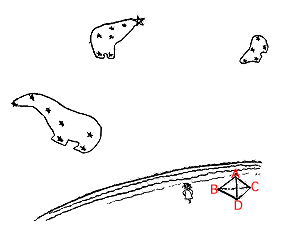
Here is Goldy having a sky party with her three friends, the Polar Bear family. Big Bear gave Mommy the Pole Star to wear on her nose when she gave birth to
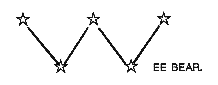
Daddy - Ursa Major, "The Big Bear" - is often called the "Big Dipper" because he drinks so much iced tea. Mommy - Ursa Minor, "The Little Bear" - is usually called the "Little Dipper" because being right at the cold North Pole she drinks much hot tea but in little cups - that way it doesn't have time to get cold, she says. Wee Bear is sometimes called Cassiopeia because he sits in the high chair Cassiopeia used when she was a baby.
Goldy says, "I have drawn Mommy Bear in reverse. I forgot when I was drawing her that if it is to be printed directly from my drawing, it required an original mirror-image master. But I am going to leave her that way because it's well to remind everyone at the outset that we can only get from here to there by a series of errors - errors forwardly to the right, then a correcting forwardly error to the left, each time reducing error but never eliminating it. This is what generates waves; this is what generates the experience life."
Goldy says the sky is a "system" because Goldy plus the Three Bears equals four entities (or star events), and it takes four events to produce a system. A system divides all the universe into six parts: all the universe outside the system (the macrocosm), all the universe inside the system (the microcosm), and the four star events A, B, C, D, which do the dividing.
Two star or three star event-entities have only "betweenness" but no "insideness."
Insideness outsideness separation begins only with completion of the six interrelationship lines of the four separate entity-producing events. The four star events A, B, C, D, have six separate, unique and most economical interrelationship lines AB, AC, AD, BC, BD, CD. These six lines and their four interconnected star-corners inadvertently produce four triangular facets of the minimum polyhedron - which four facets completely enclose the system to exclude the macrocosm and include the microcosm. A system consists at minimum of four nonsimultaneous but co-occurrent, because overlapping, yet dissimilarly beginning and enduring star entity-events of six interrelationship lines and four nothingness-window facets plus twelve unique intercovariant vertex angles - twenty-six conceptual, topological components of a system to which must be added the multiplicative, ultravisible, macrocosmic outsideness and infravisible, microcosmic insideness as well as the inseparably co-occurring inside concavity and out-side convexity and the bipoled axis of rotation of all systems: for a total component inventory of thirty-two items.
Three thousand years ago the Greek geometers named this minimum system the tetrahedron - tetra = four, hedron = sides.
A system cannot have less than four triangular polygon "faces" (or sides or windows) or less than three triangular (polygon) faces surrounding each of the system's four event corners. The triangle is the minimum polygon face. You cannot have a polygon of less than three edges. You cannot have a location fix-point that is less than one fix-point, you cannot have an event tracing line that is less than a line, you cannot have an angle that is less than a minimum angle, and you cannot have a system of less than thirty-two uniquely differentiable and geometrically describable characteristics. All the characteristics of a system are absolute because each of its components is the minimum-limit case in its respective conceptual category, for all conceptuality, as the great mathematician Euler discovered and proved, consists at minimum of points, areas, and lines. Goldy further clarifies and simplifies Euler by saying an area is nothingness, a plurality of areas are framingly separated views of nothingness, a point is a single somethingness. A line is a relationship between two somethingnesses. An enlarged, seemingly single somethingness may prove to consist of a plurality of somethingnesses between which the defined interrelationship lines fence off the nothingness into a plurality of separate views of the same nothingness. Points are unresolvable, untunable somethingness occurring in the twilight zone between visible and subvisible. Nothingness is the unresolvable untunableness occurring in the twilight zone between visible and supravisible experience.
Life minimally described is "awareness," which is inherently plural, for at minimum it consists of the individual system which becomes aware and the first minimum "otherness" of which it is aware, the otherness being either integrally internal or separately external to the observing system's fourteen integral, topologically componented subsystems (4V + 4A + 6L).
Together the observer and the observed constitute two points differentiated against an omni-environment of nothingness with one inherent line of "awareness" interrelationship running between these two points. Euler's generalized formula, which he named topology, says the number of points plus the number of areas will always equal the number of lines plus the number 2, which Goldy finds to be at minimum 2P + 1A = 1L + 2, which minimum set of awareness aspects of life add to four, i.e., (A) the observer, (B) the observed, (C) the line of interrelationship, and (D) the nothingness area against which the somethingness is observed.
There are no known experimentally demonstrable absolute maximum limits.
Only the minimum limit is demonstrably absolute. The minimum limit experience is always a system - even when it looks like a point. A point is a system so macro remote or micro small as to appear only as an indivisible something in a specific direction relationship to the observer's integral systems arrangement of, for instance, head, toe, front, and back. "That's nifty," says Wee Bear. "It's magnificent," says Big Bear. "I call it both nifty and magnificent," says Mommy Bear.
Goldy has a tetrahedron beside her on the beach. Its four vertexes (which may also be called locations; stars, event-fixes; points) are oriented as are Goldy and the Three Bears, with Mommy and her pole star at A, Daddy at B, Wee Bear at C, and Goldy at D.
The tetrahedron's four-corner star events do not have to occur at the same time. Goldy saw a man way down the beach pounding to drive a post into the sand. She heard each pounding a moment after she saw it occur. When she was told about light's speed having been measured in a vacuum by scientists, she understood that the light with which she saw the event, like sound, also had a limit speed. She was told that sound traveled at about 700 miles an hour and that light traveled a million times faster, which though very fast is much slower than 700 million miles in no time at all.
Multiplying 700 million by the number of hours in a year, Goldy found that light traveled six and one-half trillion miles in a year, and was fascinated when an astronomer told her that the star in the nose of the Big Bear is a live show taking place 210 light-years away-and-ago, as the American colonists are first thinking about revolting from English rule: and the pole star at Mommy Bear's nose is a live show taking place 680 light-years away-and-ago, as Dante is writing The Inferno: and the star at Wee Bear's front toe is a live show taking place forty-three light-years away-and-ago as Franklin Delano Roosevelt is being elected to the USA presidency for the first time, at the depth of the great 1929-39 Depression: while she, Goldy, is also a live show taking place no time away-and-ago. Altogether Goldy's four live shows constitute a scenario of nonsimultaneous but omni-interrelated events, which can and do define the four corners of a minimum system - the tetrahedron. Goldy, too, is a nonsimultaneous system. She, too, is a nonsimultaneous and only partially overlapping complex of insideness and outsideness experiences. The interrelated experience of Goldy and the Three Bears are a scenario. She now understands Einstein's concept that Universe is a scenario and not a single simultaneous structure. One picture of a caterpillar does not tell you it is going to transform into a butterfly, and it takes many frames of the cinema to inform you that the butterfly can fly and many thousands of frames to permit a possible replicative engineering discovery of how it can fly. Because of [this,] any one single "frame" or picture in the scenario filmstrip cannot disclose "what the story is all about," Goldy says to the bears, "When people look at you stars and say, 'I wonder what is outside the outside of the stars,' they are asking for a timeless, simultaneous, static-system concept where none exists. Their question is as ignorant as would be asking, 'Which word is the dictionary?' "
"You are right, Goldy," says Daddy Bear. "Minds think exploratorially, sort and compose. One thought, which is one metaphysically conceptual system, which at minimum is one tetrahedron, can interrelate any four event points or subsystems in nonsimultaneous Universe. Because of inherent nonsimultaneity all thinking is tetratuning. The (system-thought) tetrahedron can and always does include four identities: (1) the thinking individual, (2) the present otherness, (3) the past otherness, (4) the future otherness.
To which thought of Daddy Bear Mommy adds, "And the ignorant question asking of the brain occurs because brains do not think. They only play back yesterday's recordings. Brains are pretuned like bells and sound off when struck."
(R. Buckminster Fuller, Tetrascroll: Goldilocks and the Three Bears (New York, 1975), p3-7)